Alabama’s economy should continue to see modest growth through the remainder of 2013. Economists at the Center for Business and Economic Research (CBER) in The University of Alabama’s Culverhouse College of Commerce expect real GDP to increase close to 2.0 percent this year, about the same or a little below last year’s rate of expansion. Job growth could be a little stronger than in 2012, with 10,000 to 15,000 jobs added, a gain of around 0.7 percent.
Transportation equipment manufacturers will be responsible for much of the output and job gains. Demand for vehicles produced in Alabama is expected to stay strong in 2013 and production should maintain current levels. Mercedes and related suppliers will be hiring in 2013 for C-Class production; Mobile area shipbuilders are also adding to employment.
Other sectors with above-average job growth will be business and healthcare-related services. An improving real estate market could spur job gains in primary and fabricated metals and wood products manufacturing. But sluggish consumer spending gains could result in slower job growth in the leisure and hospitality sector than was seen in 2012.
After staying fairly stable over most of the past year, Alabama’s labor force growth picked up in March, keeping seasonally-adjusted unemployment unchanged from a year earlier at 7.2 percent. However, challenges to consumers and businesses, together with uncertainties about fiscal policies and the implementation of federal healthcare legislation, will keep most employers cautious about new hiring and capital investment throughout 2013.
Nonfarm jobs totaled 1,887,400 in March 2013, still 139,300 below the December 2007 peak of 2,026,700. Over the most recent 12 months, manufacturing, wholesale and retail trade, professional and business services, educational and health services, and the leisure and hospitality industry have been the primary sources of job growth. Largest job losses have come from the construction and information industries and from federal and state government.
Export growth continues be an important factor; total exports rose 9.4 percent in 2012 to $19.5 billion. Strong increases in shipments of transportation equipment and primary metals led export gains.
Alabama tax receipts totaled almost $4.6 billion for the first six months of FY2013, a 3.2 percent increase from the same period in FY2012. That compares to a 3.5 percent gain during the same period a year earlier. Appropriations to the Alabama Education Trust Fund were up just 0.4 percent for the first half of FY2013, while appropriations to the General Fund were down 12.7 percent. CBER expects FY2013 total tax receipts to be 3.5 percent higher than last fiscal year.
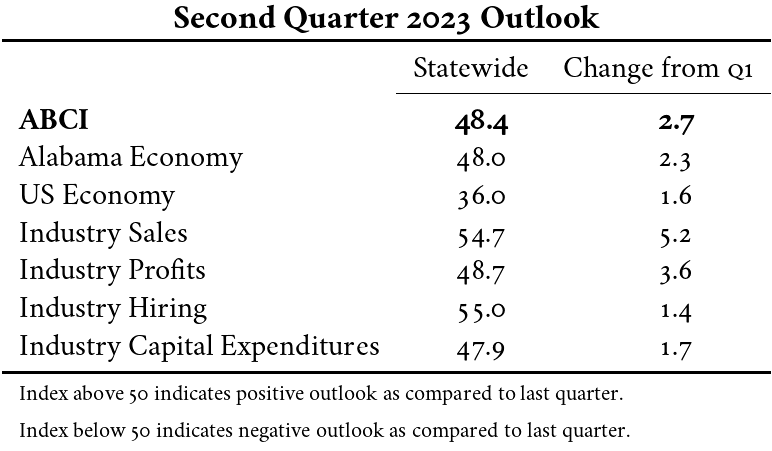
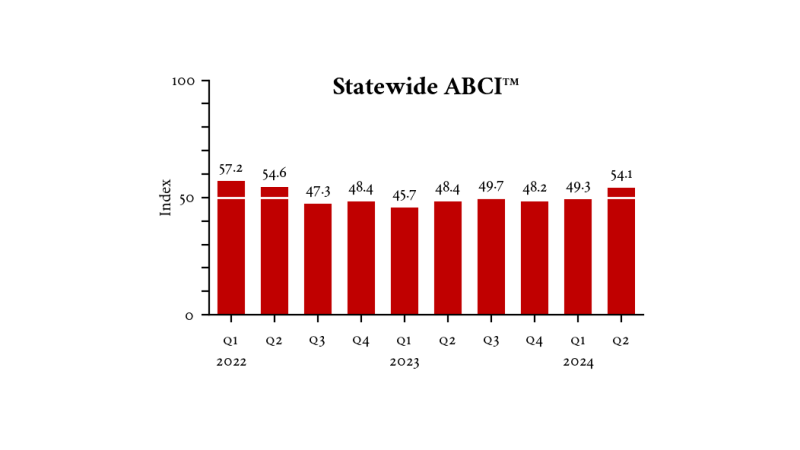
Business sentiment among executives statewide, measured by CBER’s Alabama Business Confidence Index™ (ABCI), rose 2.3 points to 47.7 on the second quarter 2013 survey. Businesses in the Birmingham-Hoover, Mobile, and Montgomery metros are generally optimistic about prospects for the quarter, while Huntsville executives registered a gloomy 35.6. Removing Huntsville from the statewide calculation, the ABCI for the remainder of the state was a mildly optimistic 51.8.
_____________________________________________________________
TUSCALOOSA, Ala.—The federal budget sequester and continuing uncertainty about fiscal policy are clearly dampening Alabama business confidence. For the state as a whole, the Alabama Business Confidence Index™ (ABCI) registered 47.7 on the second quarter 2013 survey. Although up 2.3 points, the index remains below 50 and signals a negative outlook for the third consecutive quarter. This is the 46th quarterly survey of Alabama business confidence conducted by UA’s Center for Business and Economic Research (CBER).
Gloom in Huntsville, Mild Optimism Elsewhere. Federal spending cuts are having such a sizeable negative impact on business confidence in the Huntsville metro that it’s masking more upbeat sentiment elsewhere in Alabama. Removing Huntsville, where the index registered just 35.6, from the calculation, the second quarter ABCI is 51.8, a mildly positive outlook for the rest of the state.
Economic Environment. Business executives across the state remain pessimistic about prospects for the U.S. economy. The national economy index is 40.5, with almost 52 percent of respondents expecting a worse performance this quarter than last and just 22 percent a better one. At 47.3 the second quarter 2013 Alabama economy index was about the same as last quarter. However, while the assessment of the state’s prospects fell 10 points to 32.0 in Huntsville, the rest of the state had an index of 52.5, indicating modest growth across much of Alabama this quarter.
Sales and Profits. Sales expectations are the most improved, with the index rising 3.5 points to 53.9. The profits index ticked up 2.3 points to a neutral 50. Manufacturers are the most upbeat about both second quarter sales and profits. Firms in construction; financial activities; and transportation, information, and utilities see sales improving at a better pace than last quarter. Earnings could be up moderately in the financial activities sector. But sales and profits expectations continue to be negative in healthcare and in professional, scientific, and technical services.
Hiring and Capital Expenditures. Alabama firms continue to be cautious about adding jobs or making capital expenditures. The hiring index is up slightly to 46.8. About half of business executives expect no change in hiring and 28.4 percent plan to cut back, indicating that job growth will be modest. Capital spending will also be weaker overall than last quarter, with the index at 47.7. Manufacturers should be the primary source of jobs and investment in the second quarter. Firms in healthcare and professional services could see sharp reductions in hiring and capital spending.
Metro Areas. Business confidence in the Huntsville metro fell 4.8 points to 35.6, its lowest reading since the survey began. Optimism rebounded strongly in Montgomery as confidence climbed 9.0 points to 53.3, highest among the metro areas. Birmingham-Hoover executives are also more optimistic this quarter; the area’s ABCI rose 2.0 points to 52.7. Business sentiment in Mobile moved back into positive territory, with a 2.7 percent increase to 51.4. Job growth should improve slightly in Birmingham-Hoover and Montgomery, while capital spending is likely to pick up modestly in the Birmingham-Hoover and Mobile metro area.
Firm Size. Alabama’s largest businesses, employing 100 or more, are mildly optimistic about their second quarter prospects, with the ABCI rising 2.0 points to 51.4. Although hiring will be flat, sales, profits, and capital spending are expected to increase. While smaller firms anticipate higher sales this quarter, they continue to report weaker prospects for profits, hiring, and investment. The ABCI for businesses with 20 to 99 employees was 45.9, while the index for firms employing fewer than 20 registered 45.0.
_____________________________________________________________
The momentum in Alabama’s economy during the second half of 2012 should continue into 2013, according to the forecast from UA’s Center for Business and Economic Research (CBER). Dr. Sam Addy, CBER Director and Associate Dean for Research and Outreach in the Culverhouse College of Commerce, discussed developments in the state during 2012 and prospects for 2013 at the Center’s 25th annual Economic Outlook Conference. Around 160 attended the meeting, held January 16th in Montgomery.
Real GDP growth of 1.7 to 1.9 percent is forecasted for 2013, with employment gains of almost 1.1 percent, or around 18,500 net new jobs, during the year. Growth could be stronger if uncertainty is reduced concerning fiscal policy at the national level. Total state tax revenues are expected to rise around 3.5 percent in FY2013, slightly below the 3.8 percent rate of increase seen in FY2012.
Strong gains in Alabama’s automotive manufacturing industry, increasing exports, and an improving housing market will add to the momentum this year. Rising wages and income across the state indicate that consumer spending will be a positive for growth going forward. Firms in industries including professional and business services, healthcare, tourism, and retail trade will also contribute to employment gains during 2013.
Dr. Addy discussed the importance of addressing how we could apply resources to ensure continuing improvement in the state’s economy. Enhancing education and workforce development programs are key to providing workers with the skills needed by new and expanding businesses. Alabama currently has an available labor pool of around 650,000 residents who are either unemployed or underemployed (employed but looking for better jobs). But the demographics of an aging population together with slow population growth mean that the state will have to look to both domestic and international in-migrants and to increased labor force participation, training, and productivity to keep economic growth strong in the longer term.
Looking at prospects for the U.S. economy, Dr. David Altig, executive Vice President and Director of Research at the Federal Reserve Bank of Atlanta, expects GDP growth in the 2.3 to 3.0 percent range during 2013 as the nation continues to climb out of a deep hole. The Federal Reserve will exercise its tools of very low interest rates and quantitative easing until the economy improves significantly. Resolving federal fiscal policy uncertainty is critical to unleashing stronger potential for growth.
Retirement Systems of Alabama CEO, Dr. David Bronner, took a look at past and future economic concerns. At the national level, investing in infrastructure and improving access to education are essential to ensuring future competitiveness. Resolving the gridlock in Washington will encourage business investment. Alabama has made a lot of progress over the last 15 years in areas including tourism, the auto industry, and aerospace. But, as Dr. Bronner noted, education is the key ingredient in a better future for all our citizens.
The 2013 Economic Outlook Conference was sponsored by the Alabama Department of Economic and Community Affairs, Alabama International Trade Center, Alabama Power, Alabama SBDC Network, BlueCross BlueShield of Alabama, Boeing, Hyundai Motor Manufacturing Alabama, Lockheed Martin Space Systems, PowerSouth Energy Cooperative, ServisFirst Bank, Sterne Agee, and Vulcan Materials.
View presentations from the 2013 Economic Outlook Conference
Dr. David Altig’s presentation: The Economy—A View from the Fed
Dr. Sam Addy’s presentation: The Alabama Outlook
Check out press coverage of the 2013 Economic Outlook Conference
al.com (Birmingham News, Huntsville Times, Mobile Press Register)
The Anniston Star
The Gadsden Times
The Montgomery Advertiser
The Tuscaloosa News
_______________________________________________________________
The Center for Business and Economic Research is now making its detailed forecast tables of Alabama output and employment by sector available quarterly. Table releases in January, April, July, and October are generated by the Center’s Alabama Econometric Model based on current economic conditions and expectations.
To order the current quarter's forecast tables and pay by credit card, please go to the CBER Store, or send a check for $30 payable to The University of Alabama to: Center for Business and Economic Research, Box 870221, Tuscaloosa, AL 35487-0221.
![]()
Would you like to know when CBER has a new publication or when research briefs or data are added to this Web site? Then sign up for CBER News Service. You will receive timely messages alerting you to CBER's additions. Send your name and email address to uacber@cba.ua.edu. It's as easy as that!
![]()
![]()
CBER Home | Culverhouse College of Commerce | UA | Webmaster | Subscribe | Disclaimer
Center for Business and Economic Research, Box 870221, Tuscaloosa, AL 35487-0221
Phone: 205.348.6191, Fax: 205.348.2951, Email: uacber@cba.ua.edu